Two houses on the same street, similar size, similar condition — one sells in a week with several competing offers, the other sits on the market for months with barely a viewing. Sellers almost always assume this comes down to the property. Usually, it comes down to the launch.
A trickle of viewings vs a concentrated event
The most common mistake in a slow sale is a property drip-fed to the market — a viewing here, a viewing there, spread over weeks. Each buyer views alone, with no sense that anyone else is interested, and no urgency to act. A structured open house does the opposite: it puts every serious buyer in the property on the same day, so interest becomes visible to the buyers themselves, not just the agent.
Property services in Northumberland
- Estate agents in Northumberland
- Sell my house in Northumberland
- Free property valuation
- Conveyancing solicitors and quotes
- Whole-of-market mortgage advice
- RICS property surveys
- Find your town
Find out what your home is really worth
Book a Selling Advice Meeting and Valuation with Our Agents. An honest figure for your home, a clear plan to sell it, and our complete selling package at £1,299.
Book a valuationWhy timing the launch matters as much as the marketing
Even strong photography and a well-built early-access campaign can underperform if the open house itself is scheduled badly — a weekday afternoon slot competes with work and school pickups, while a well-chosen weekend window maximises how many interested buyers can actually attend at once. Getting the date and time right isn't a minor logistical detail; it's part of what determines whether the concentrated demand a launch has built actually converts into people in the room.
Cold traffic vs a warmed-up audience
A listing that goes straight onto the portals with no lead-up reaches a cold audience — buyers scrolling who've never heard of the property before. An early-access campaign changes that, building interest before the listing is even fully live, so day one brings a warmed-up pool of buyers rather than a slow trickle of first-time viewers discovering it over weeks.
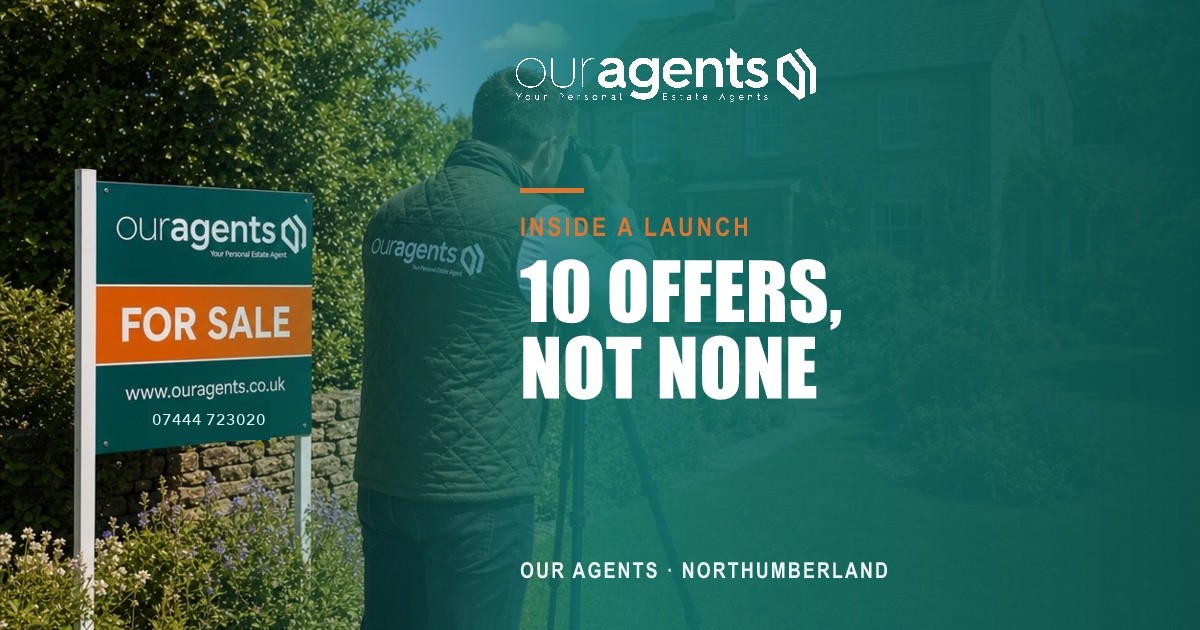
Ten offers and none aren't usually two different properties. They're usually two different launches.
A phone photo vs professional presentation
Listings marketed with professional photography and video get measurably more attention — 85% more views, in our own data — simply because they look like something worth clicking on. This isn't about the property being better; it's about the same property being presented in a way that earns the click in a crowded portal search.
No deadline vs real competition
Without a defined moment for offers, buyers can deliberate indefinitely, and a seller has no leverage to bring that deliberation to a close. A structured open house creates a natural deadline — buyers know other people are viewing the same day, and that changes the psychology of the decision from "I could think about it" to "I need to decide now."
The role of pricing strategy
None of this works if a property is priced unrealistically to begin with — a concentrated launch creates competition among buyers who believe the price is fair, not buyers hoping to negotiate a listing down. Getting the asking price right from day one, based on genuine comparable evidence rather than an optimistic guess, is what makes the rest of the process — the photography, the early-access campaign, the open house — actually convert into offers rather than just footfall.
What this looks like in practice
Across two recent launches run this way, we generated 53 viewings and 10 offers between them — not because the properties were unusually special, but because the process concentrated genuine demand into a single moment instead of letting it dissipate over months. Around 95% of our properties sell at the open house itself, for the same reason.
If you want a launch built around getting real competition for your home rather than a slow trickle of viewings, the place to start is a Selling Advice Meeting and Valuation.
Book a Selling Advice Meeting and Valuation