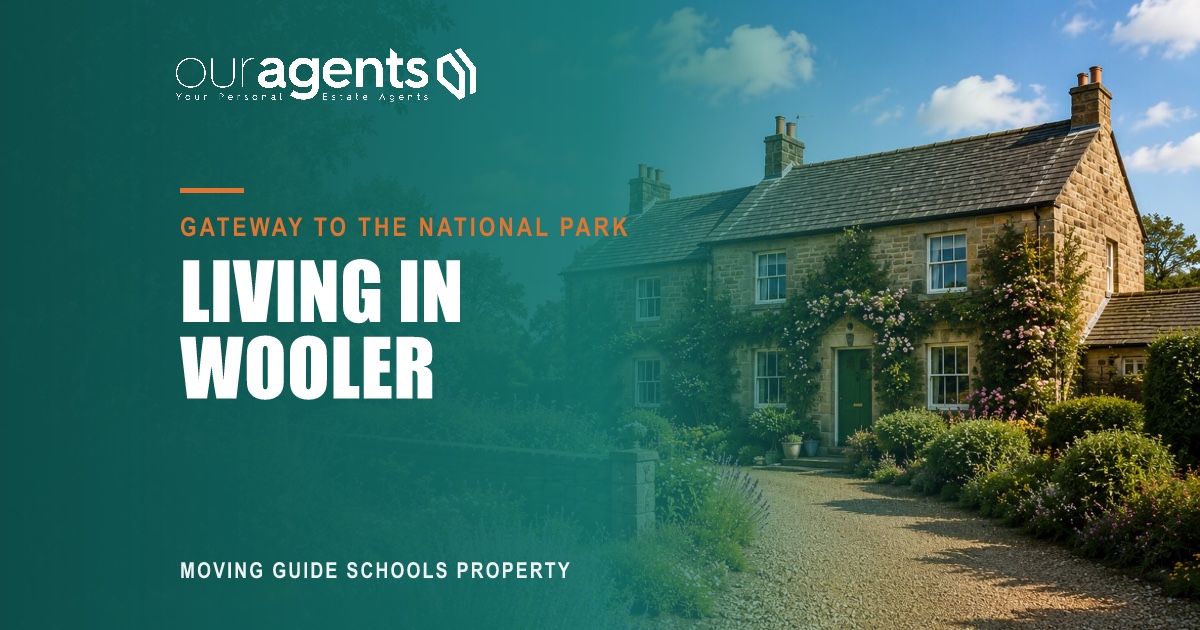
Wooler sits at the foot of the Cheviot Hills in the far north of Northumberland, roughly 40 miles from Newcastle and 15 miles south of Berwick-upon-Tweed. It is the last proper market town before the road climbs into Northumberland National Park — and that position, at the edge of England’s wildest upland landscape, is precisely what draws buyers to it from across the country.
A small town with a serious natural backdrop
Wooler’s population sits around 2,000, which makes it compact by any measure. But the town punches well above its size: there is a good range of independent shops along the high street, a supermarket, a GP surgery, a dentist, a library and a cluster of cafés and pubs that serve both locals and the steady flow of walkers, cyclists and dark-sky tourists who pass through year-round.
The Northumberland National Park boundary begins almost at the edge of town, and the Cheviot Hills — whose flanks are visible from most streets — give Wooler a sense of drama that is unusual for a market town of its size. The Harthope Valley, Hedgehope Hill and the summit of The Cheviot itself are all within striking distance on foot or by bicycle.
“The national park boundary begins almost at the edge of town. For buyers who want genuine rural life without giving up a real community, Wooler delivers.”
Property services in Wooler
- Estate agents in Wooler
- Sell my house in Wooler
- Free property valuation in Wooler
- Conveyancing solicitors in Wooler
- Mortgage advisers in Wooler
- Property surveys in Wooler
Find out what your home is really worth
Book a Selling Advice Meeting and Valuation with Our Agents. An honest figure for your home, a clear plan to sell it, and our complete selling package at £1,299.
Book a valuationWho is buying in Wooler?
The buyer profile here is unlike most Northumberland towns. A significant proportion of purchasers are incomers making a deliberate lifestyle move: remote workers leaving larger cities, retirees prioritising outdoor life over urban convenience, and — increasingly — younger families priced out of Alnwick or Morpeth who are prepared to trade daily commutability for space and genuine value.
There is also a second-home and holiday-let market driven by the town’s proximity to both the national park and the Northumberland coast. Buyers in this bracket tend to target stone cottages and traditional terraces on or close to the high street, with the rental potential that a tourist-facing location provides.
What unites most buyer types is a clear sense of what they are choosing. People who search for Wooler have already done their research — they are not here by accident. That focus produces motivated buyers who make decisions quickly once they find the right home.
Schools and family life
Wooler operates on a three-tier schooling system — first school, middle school and then secondary — which differs from most of England and is worth understanding before relocating with children. Glendale First School serves the earliest years locally. Glendale Middle School takes pupils through to Year 8. Most pupils then continue to Berwick Academy, around 15 miles north, for secondary education.
For families, the outdoor dimension is a genuine draw rather than a nice-to-have. Weekend mornings in Wooler tend to involve the hills, the River Glen or the network of bridleways rather than a retail park. If that lifestyle resonates, the town will feel like a natural fit from the first visit.
Transport and connectivity
Wooler is not a conventional commuter town. The nearest railway stations are Berwick-upon-Tweed (approximately 15 miles north) and Alnmouth (approximately 30 miles south), both on the East Coast Main Line with fast services into Newcastle. For buyers who need to travel south regularly, the A697 is the main road artery through the county and links efficiently to the A1 corridor.
Broadband and mobile coverage have improved considerably across north Northumberland in recent years, and ultrafast connectivity now reaches a growing number of properties in and around the town. For buyers who work remotely or travel to the city one or two days a week, the connectivity picture is more workable than the map distance might suggest.
The property market in Wooler
Wooler offers some of the most accessible property values in Northumberland relative to what you receive in return. Stone-built terraces and semi-detached houses on town-centre streets represent genuine value compared with equivalent properties in Morpeth, Corbridge or Ponteland. New-build supply in and around the town is limited, which tends to underpin values and reduces the downward pressure on older stock that can affect larger development sites elsewhere in the county.
Detached cottages in the surrounding villages — Wooler’s network of hamlets extends into the national park itself — command a meaningful premium, particularly where they offer land, outbuildings or uninterrupted views across the Cheviots. Demand for this type of property from relocation and lifestyle buyers remains consistent, and supply is perennially limited. When one comes to market in good condition, competition between buyers is real.
If you own a property in Wooler or the surrounding national park villages and are thinking about selling, the key is to present it against what makes it genuinely special: access to the park, the quiet, the community and the space. These are what your buyers are purchasing. Getting that story right from day one — with professional photography, a well-timed open house and a structured launch — is what separates a fast sale at the asking price from a slow one that drifts.